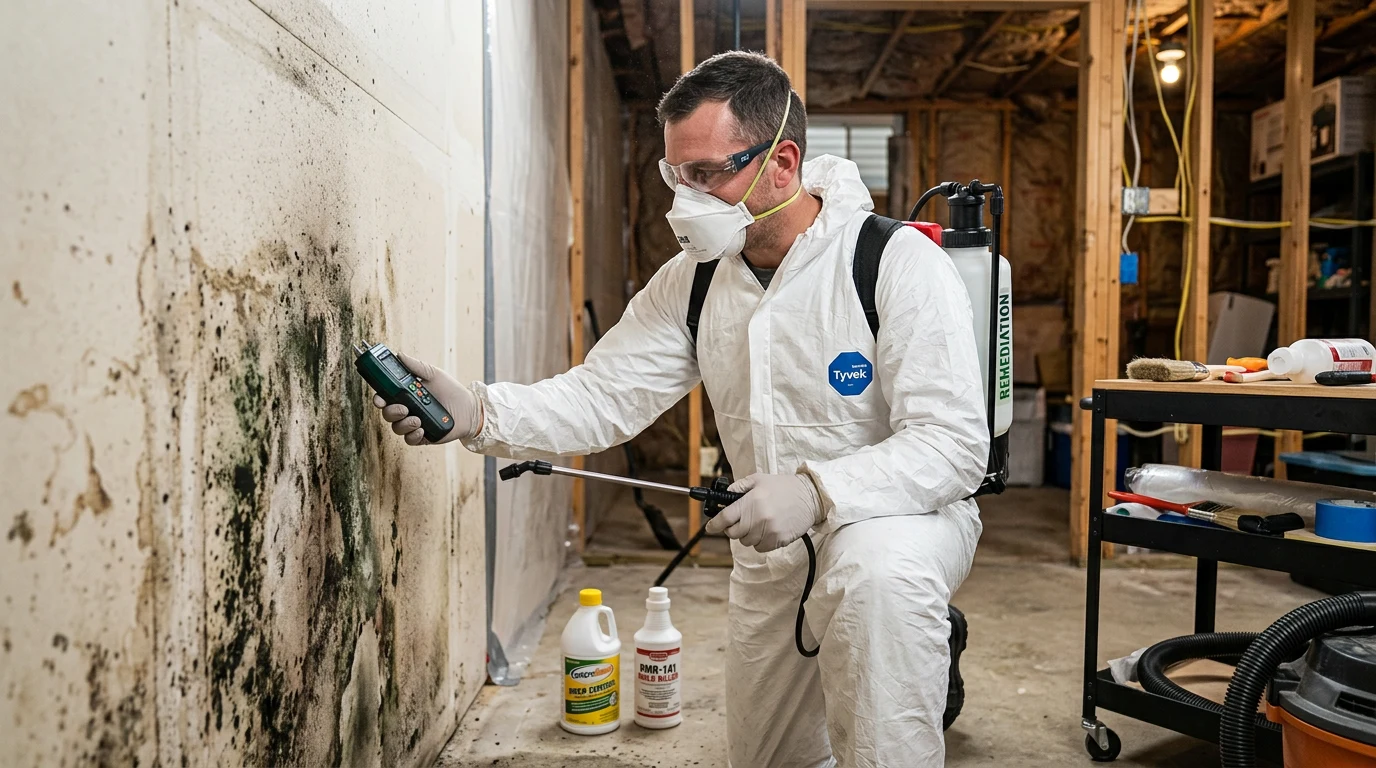
RMR-141 and Concrobium Mold Control represent the two leading EPA-registered antimicrobial options available to homeowners. Unlike bleach-based products that only kill mold on contact, both RMR-141 and Concrobium provide residual protection that prevents mold regrowth. The key difference lies in their chemistry: RMR-141 uses quaternary ammonium compounds while Concrobium uses inorganic alkaline salts. This RMR-141 vs Concrobium comparison breaks down which chemistry works better for specific situations.
Affiliate Disclosure: MoldActionPlan.com earns commissions from qualifying purchases through our affiliate links at no extra cost to you. Our recommendations are based on aggregated buyer reviews, manufacturer specs, and expert analysis. Full disclosure.
Review Methodology: Products in this comparison have not been independently purchased or tested by our team. Recommendations are based on aggregated verified buyer feedback, manufacturer specifications, ingredient analysis, and published expert opinion. We disclose affiliate relationships where present.
Quick Comparison: RMR-141 vs Concrobium
| Feature | RMR-141 RTU | Concrobium Mold Control |
|---|---|---|
| EPA Registered | Yes (Reg. No. 6836-349-87742) | Yes (Reg. No. 82552-1) |
| Active Ingredient | Quaternary ammonium compound | Trisodium phosphate + sodium carbonate |
| Kill Spectrum | 140+ microorganisms (mold, bacteria, viruses) | Mold and mildew species |
| Prevention Mechanism | Residual antimicrobial film | Crystalline barrier (physical crushing) |
| Removes Stains | Minimal | None |
| Odor | Mild, pleasant scent | None (zero VOCs) |
| Fogger Compatible | No (RTU formula) | Yes |
| Application | Spray, wipe, 10 min contact time | Spray or fog, air dry (no wipe) |
| Also Disinfects | Yes (bacteria + viruses) | No (mold/mildew only) |
| Price (32 oz) | ~$10–$13 | ~$10–$13 |
| Buyer Rating | 4.6/5 (490+ reviews) | 4.3/5 (10,000+ reviews) |
Chemistry Deep Dive
RMR-141: Quaternary Ammonium Technology
RMR-141 RTU uses a positively-charged quaternary ammonium compound (commonly called a “quat”) as its active ingredient. Quats work by attracting to and bonding with negatively-charged microbial cell membranes, disrupting their structure and causing cell death. This ionic attraction mechanism gives RMR-141 two key advantages: it actively seeks out microorganisms on treated surfaces, and it creates a residual antimicrobial layer that continues to kill new organisms that contact the treated surface.
RMR-141’s broad kill spectrum covers over 140 different microorganisms including mold, mildew, bacteria (MRSA, E. coli, Salmonella), and viruses (SARS-CoV-2, Influenza, Norovirus). This makes it a true multi-purpose disinfectant suitable for post-water damage situations where bacterial contamination may accompany mold growth.
Concrobium: Inorganic Salt Technology
Concrobium Mold Control uses a patented blend of trisodium phosphate, sodium carbonate, and sodium bicarbonate. As the solution dries, these inorganic salts crystallize into a thin, invisible film that physically crushes mold spores at the microscopic level. The dried film’s highly alkaline pH (above 10) creates an environment where mold cannot survive or recolonize.
Concrobium’s kill spectrum is narrower than RMR-141’s — it targets mold and mildew species specifically. It does not carry disinfectant claims against bacteria or viruses. However, its physical crushing mechanism and alkaline barrier provide reliable mold prevention that has been independently verified through EPA testing.
Key Differences That Matter
Fogger Compatibility
This is Concrobium’s most significant practical advantage. Concrobium can be used with cold foggers to treat entire rooms, HVAC systems, and enclosed spaces. The zero-VOC formula makes fogging safe and practical. RMR-141’s ready-to-use formula is not designed for fogging — it is a spray-and-wipe product.
For whole-room treatment of basements, crawl spaces, or attic spaces, Concrobium’s fogger compatibility is a decisive advantage. For targeted surface treatment, both products work equally well as sprays.
Disinfection Beyond Mold
RMR-141 wins for situations involving contamination beyond mold. After flooding, sewage backup, or water damage, bacterial and viral contamination often accompanies mold growth. RMR-141’s broad-spectrum antimicrobial action addresses all three threats simultaneously. Concrobium only addresses mold and mildew.
Application Method
Concrobium is applied and left to dry — no wiping required. The air-dry process is what forms the protective crystalline barrier. Wiping Concrobium off before it dries defeats the purpose.
RMR-141 requires spraying, a 10-minute contact time for full antimicrobial effect, then wiping or allowing to air dry. The active disinfection happens during the wet contact period.
When to Choose RMR-141
- Post-water damage or flood remediation requiring full disinfection
- Situations where bacterial or viral contamination may accompany mold
- Professional remediation requiring EPA-documented broad-spectrum kill claims
- Pairing with RMR-86 for a same-brand stain-removal-plus-prevention system
- When a pleasant scent is preferred over zero scent
When to Choose Concrobium
- HVAC and ductwork treatment requiring a fogger
- Whole-room preventive treatment (basements, crawl spaces, attics)
- Preventive application before mold appears
- Zero-VOC requirement (sensitive occupants, enclosed spaces)
- When a no-wipe, spray-and-forget application is preferred
- Budget is similar — the deciding factor is application method
Frequently Asked Questions
Which is more effective at killing mold, RMR-141 or Concrobium?
Both are EPA-registered and proven effective against mold. RMR-141 has a broader kill spectrum (140+ organisms vs mold-focused) while Concrobium has a unique physical crushing mechanism. For mold specifically, both provide equivalent results. Choose based on application method needs: Concrobium for fogging, RMR-141 for surface spraying and multi-purpose disinfection.
Can RMR-141 be used in a fogger?
The RTU (ready-to-use) formula of RMR-141 is not designed for fogging. It is formulated for direct spray application with a 10-minute wet contact time. For fogging applications, Concrobium is the better choice. RMR Solutions does offer professional-grade concentrates that may be suitable for ULV foggers, but these are separate products from the RTU consumer version.
Do either of these products remove mold stains?
Neither RMR-141 nor Concrobium effectively removes dark mold staining. Both kill the organism and prevent regrowth, but the melanin-based discoloration remains. For stain removal, use a bleach-based product like RMR-86 or Mold Armor before applying either antimicrobial product.
What is the primary difference between RMR-141 and Concrobium Mold Control?
The main distinction lies in their active ingredients and mechanisms of action. RMR-141 uses sodium hypochlorite to kill mold, while Concrobium employs a proprietary blend of inorganic salts that encapsulate and crush mold spores as it dries.
Are both RMR-141 and Concrobium Mold Control EPA-registered for mold killing?
Yes, both products are EPA-registered disinfectants and fungicides, meaning they have been tested and approved by the Environmental Protection Agency for their efficacy against mold. This registration ensures they meet specific safety and performance standards for mold remediation.
Which product, RMR-141 or Concrobium, is better for removing mold stains?
RMR-141, due to its sodium hypochlorite base, is generally more effective at bleaching and removing mold stains, often providing a visibly cleaner surface. Concrobium primarily focuses on killing the mold and preventing regrowth, with less emphasis on stain removal.
Can I use RMR-141 and Concrobium on the same surfaces?
While both can be used on many surfaces, it’s generally not recommended to mix or immediately follow one with the other without proper rinsing. RMR-141’s bleaching action might affect materials differently than Concrobium’s film-forming properties, and chemical interactions could occur.

Is one product safer to use around children and pets than the other?
Concrobium Mold Control is often marketed as a non-toxic, non-bleaching, and fume-free solution, making it a potentially gentler option for households with children and pets once dry. RMR-141, containing bleach, requires more stringent ventilation and protective measures during application due to its stronger chemical nature.
Which product is more effective at preventing mold regrowth?
Concrobium Mold Control is specifically designed to create an invisible, antimicrobial barrier that prevents new mold spores from attaching and growing on treated surfaces. While RMR-141 kills existing mold, it doesn’t leave a lasting protective barrier against future growth in the same way.
Final Verdict
RMR-141 and Concrobium are both excellent EPA-registered antimicrobial products. The choice comes down to application method and scope of protection needed. Choose Concrobium for fogging capability, whole-room treatment, and zero-VOC requirements. Choose RMR-141 for broad-spectrum disinfection beyond mold, post-water-damage remediation, and pairing with RMR-86 for a complete same-brand system. At equivalent price points, either product delivers reliable mold prevention.
Read the full review: Concrobium Mold Control review · RMR-86 Mold Remover review
These statements have not been evaluated by the Food and Drug Administration. This information is not intended to diagnose, treat, cure, or prevent any disease. Content is for informational purposes only and is not medical advice; consult a qualified healthcare provider before starting any supplement. As an Amazon Associate we earn from qualifying purchases.