Does a Dehumidifier Help With Mold?
As an Amazon Associate, we earn from qualifying purchases. MoldActionPlan is reader-supported.
Yes, a dehumidifier helps with mold
A dehumidifier is one of the most effective tools you can use to prevent mold growth and stop existing mold from spreading. Mold needs moisture to grow. If indoor relative humidity stays above 60%, you create an environment where mold thrives. A dehumidifier pulls excess moisture from the air, dropping humidity into the safe zone where mold cannot establish or spread.
But a dehumidifier is not a mold killer. It will not remove mold stains or kill mold spores already embedded in porous surfaces. It manages the air, not the surface. For active mold, you still need a cleaning product and physical removal. The dehumidifier keeps the cleaned area dry so mold does not grow back.
How mold and humidity are connected
Mold reproduces through tiny airborne spores that float through every home. These spores are harmless in small numbers. They become a problem only when they land on a damp surface and start colonizing. The single factor that determines whether that happens is moisture.
The Environmental Protection Agency (EPA) recommends keeping indoor relative humidity between 30% and 50% to control mold growth. Above 60%, many common mold species, including Stachybotrys chartarum (often called black mold), can begin growing within 24 to 48 hours.
A dehumidifier is the primary tool homeowners use to keep humidity in that safe range, especially in naturally damp areas like basements, crawl spaces, and bathrooms without adequate ventilation.
Where mold grows and why
Mold appears in areas where moisture collects: basements after rain, bathrooms after showers, laundry rooms, kitchens near sinks, attics with poor ventilation, and crawl spaces. Even a small plumbing leak or condensation on cold pipes can raise local humidity enough to trigger growth. A dehumidifier addresses the underlying humidity that feeds all these problem areas.
What a dehumidifier actually does for mold control
Prevents new growth
This is where a dehumidifier is most effective. By keeping relative humidity below 50%, you remove the moisture that mold spores need to germinate. The unit runs until the air reaches your set humidity level, then shuts off and cycles back on when humidity rises again. This ongoing control is what keeps mold from returning to cleaned surfaces.
Slows existing growth
If you already have mold, a dehumidifier will not kill it, but it will stop it from spreading. Mold colonies expand by sending out hyphae (root-like structures) into porous materials. Lower humidity slows this process dramatically, buying you time to address the existing problem.
Reduces musty odors
Musty smells are caused by microbial volatile organic compounds (MVOCs) released by active mold colonies. Drying the air reduces mold activity and the associated odor. Many users report noticeable smell improvement within days of running a dehumidifier.
Deters dust mites
Dust mites, another common allergen source, also need humidity above 50% to survive. Running a dehumidifier helps control both mold and dust mites simultaneously, improving indoor air quality on two fronts.
What a dehumidifier cannot do
A dehumidifier will not remove mold stains. Mold discoloration on walls, ceilings, grout, and wood requires a dedicated cleaner. It will not kill mold spores embedded inside drywall, wood, or carpet. And it is useless if the moisture source is a leak, flooding, or condensation from poor insulation. Those issues must be fixed at the source. Using a dehumidifier on a room with an active leak just means you are drying out water that keeps coming back.
The EPA is explicit: the way to deal with mold is to fix the moisture problem and clean up the mold. A dehumidifier helps with the first part but not the second.
How to use a dehumidifier for mold prevention
Choose the right size for your space
Dehumidifiers are rated by the pints of water they remove per day. A small unit covering 1,500 to 1,800 square feet works for a single room, bedroom, or small basement. For a full basement or large open area, you need a higher-capacity unit. Oversizing is better than undersizing a unit that cannot keep up will never get your humidity to the target range.
For small to medium spaces (up to 1,800 sq ft), the hOmeLabs 1,800 Sq Ft Dehumidifier (8 pint / 24 pint max, $174.99) offers Wi-Fi control and whisper-quiet 38 dB operation. It includes a 3.3 ft drain hose for continuous drainage. At 4.5 stars with over 28,000 ratings, it is a well-reviewed compact option.
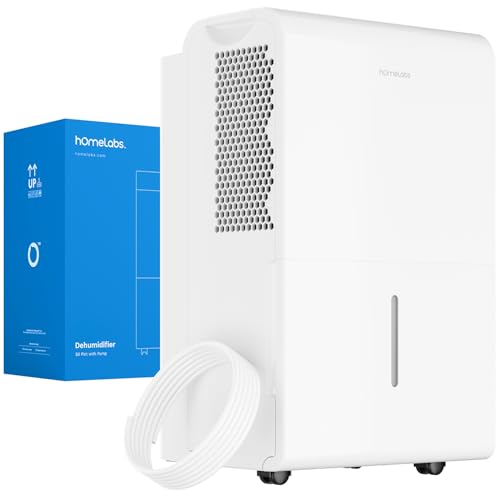
For larger spaces up to 7,500 sq ft, the hOmeLabs 7,500 Sq Ft Dehumidifier with Pump (50 pint / 120 pint max, $309.99) has a built-in pump for continuous drainage up or out of a basement window. It also scored 4.5 stars with the same review base. The pump eliminates the need to empty a bucket in high-humidity basements.
Another strong option is the Midea Cube 20 Pint Dehumidifier ($184.00, 4.2 stars, 2,263 ratings), which covers 1,500 sq ft with a unique extendable tank that holds 3.2 gallons, up to three times longer between empties than conventional units. It is ENERGY STAR certified and works with Alexa.
Set the target humidity correctly
Set your dehumidifier to 50% relative humidity. This is the sweet spot. Below 30% can cause dry skin, static electricity, and cracked wood furniture. The unit will cycle on and off to maintain the level. Do not set it to “continuous” unless you are actively drying out a wet area after a leak or flood.
Track humidity with a hygrometer
Most dehumidifiers have a built-in humidity readout, but they measure conditions at the unit. A separate hygrometer placed across the room gives you a more accurate picture. The TempPro TP50 Digital Hygrometer ($10.99, 4.6 stars, 153,000+ ratings) is the best-selling option on Amazon. It shows temperature and humidity with a wellness indicator (DRY / COMFORT / WET). Place one in each room where you are monitoring mold risk.
Position it properly
- Central location. Place the dehumidifier in the middle of the room, away from walls and furniture, so air circulates freely around it.
- Keep doors slightly open in connected rooms so air moves between spaces. In a closed room it will dry only that room.
- Elevate slightly (on a stand or shelf) if the space has flooding risk. Most units sit on the floor, but if a basement floods, a floor-level unit can be damaged.
- Leave space around the intake and exhaust. At least 6 inches on all sides.
Maintain the unit
- Clean the washable filter every two weeks during regular use. A clogged filter reduces airflow and efficiency.
- Empty the bucket regularly if not using continuous drain. Standing water in the bucket can itself become a mold source if left too long.
- Use a drain hose connected to a floor drain or sump pump for hands-off operation, especially in basements you do not visit daily.
Comparison table
| Product | Best For | Coverage | Capacity | Price | Rating |
|---|---|---|---|---|---|
| hOmeLabs 1,800 Sq Ft | Small rooms, bedrooms | 1,800 sq ft | 8 pt (24 pt max) | $174.99 | 4.5 / 5 |
| Midea Cube 20 Pint | Medium basements | 1,500 sq ft | 20 pt/day | $184.00 | 4.2 / 5 |
| hOmeLabs 7,500 Sq Ft with Pump | Large basements, whole floor | 7,500 sq ft | 50 pt (120 pt max) | $309.99 | 4.5 / 5 |
Best practices for cleaning mold alongside dehumidifier use
If you already see mold, follow this order of operations:
- Fix the moisture source. A dehumidifier alone will not stop a leaky pipe, a cracked foundation wall, or condensation from poor insulation. Repair the source first.
- Clean visible mold. For small areas (under 10 sq ft), use an EPA-registered mold cleaner. The Concrobium Mold Control Spray ($13.48, 32 oz, EPA registered, 4.1 stars, 2,065 ratings) kills mold on contact, is bleach-free and odorless, and leaves an invisible barrier that resists future growth. It works on drywall, wood, tile, grout, concrete, and fabric.
- Remove stains separately. Mold may still leave a visible stain after it is dead. The RMR-86 Instant Mold Stain Remover ($29.99, 1 gallon, 4.4 stars, 66,000+ ratings) is a professional-strength stain remover that works in 15 seconds without scrubbing. Note that this product removes stains only. It is not a mold killer. Use full PPE (respirator, gloves, eye protection) when applying it. The chemical odor is strong, and reviewers consistently warn about skin exposure.
- Run the dehumidifier continuously at 50% RH for at least 48 hours after cleaning to ensure the area dries completely.
- Monitor with a hygrometer for the next two weeks to confirm humidity stays in the safe range.
When to seek professional help
Some mold problems require a certified mold remediation professional, not just a dehumidifier and a spray bottle. Call a professional if:
- The affected area is larger than 10 square feet (roughly a 3 ft x 3 ft patch).
- Mold is inside HVAC ductwork or behind walls where you cannot reach it.
- The moisture source is structural: a leaking roof, foundation crack, rising damp, or sewage backup.
- Someone in the home has asthma, allergies, a compromised immune system, or chronic respiratory issues.
- You suspect black mold (Stachybotrys) and see a slimy, dark green-black growth on water-damaged materials.
- The musty smell persists even after cleaning and dehumidifying.
The EPA and CDC both recommend professional remediation for any mold problem covering more than 10 square feet or involving HVAC contamination. A dehumidifier is a support tool, not a substitute for proper remediation in these cases.
FAQ
Can a dehumidifier make mold worse?
Indirectly, yes, if not maintained properly. If the water collection bucket is not emptied regularly, standing water can grow bacteria and mold inside the unit. Some users report the standing water smell recirculating into the room. Clean the bucket and filter regularly, and use a continuous drain hose when possible to avoid this issue.
How long should I run a dehumidifier for mold prevention?
Run it until indoor humidity stays below 50% consistently. In humid climates, this often means running it daily or indefinitely during summer months. Most modern units with a built-in humidistat cycle on and off automatically to maintain the target level. You do not need to run it 24/7; the humidistat handles the timing.
Should I use a dehumidifier or air purifier for mold?
Use both, for different reasons. A dehumidifier controls the moisture that mold needs to grow. An air purifier with a HEPA filter captures airborne mold spores. Together they address different parts of the problem. Start with the dehumidifier to fix the humidity. Add a HEPA air purifier if you still notice musty smells or if someone in the home has respiratory sensitivity.
Frequently Asked Questions
Will a dehumidifier kill mold?
No. A dehumidifier removes moisture from the air but does not kill mold spores or remove existing mold. It prevents new growth and slows existing growth by removing the moisture mold needs to spread. You still need to clean and remove any mold you can see.
What humidity level stops mold growth?
Keep indoor relative humidity below 50% to prevent mold growth. The EPA recommends 30% to 50% as the safe range. Above 60%, many mold species can start growing within 24 to 48 hours.

Can a dehumidifier make mold worse?
Indirectly, yes, if not maintained properly. If the water collection bucket is not emptied regularly, standing water can grow bacteria and mold inside the unit.
How long should I run a dehumidifier for mold prevention?
Run it until indoor humidity stays below 50% consistently. In humid climates, this often means running it daily or indefinitely during summer months. Most modern units with a built-in humidistat cycle on and off automatically.

Should I use a dehumidifier or air purifier for mold?
Use both, for different reasons. A dehumidifier controls the moisture that mold needs to grow. An air purifier with a HEPA filter captures airborne mold spores. Together they address different parts of the problem.

These statements have not been evaluated by the Food and Drug Administration. This information is not intended to diagnose, treat, cure, or prevent any disease. Content is for informational purposes only and is not medical advice; consult a qualified healthcare provider before starting any supplement. As an Amazon Associate we earn from qualifying purchases.
