A supply line under the kitchen sink burst at 3 PM on a Friday. The homeowner was at work. By the time they arrived home at 6 PM, water had been flowing for three hours — roughly 600-900 gallons based on a typical 1/2-inch supply line flowing at 3-5 gallons per minute. The kitchen floor was flooded. Water had migrated through the doorway into the dining room. It seeped through the subfloor into the finished basement below, saturating the ceiling drywall and dripping onto carpet.
The homeowner mopped up what they could, put down towels, and decided to “deal with it properly on Monday” when they could call a plumber and their insurance company. That 60-hour delay — from Friday evening to Monday morning — turned a $2,000 water extraction and drying job into a $30,000 nightmare involving full basement demolition, structural drying, mold remediation, and reconstruction.
This scenario plays out thousands of times a year across the country. The damage from the water is bad. The damage from waiting is catastrophic.
Hour by Hour: What Happened While They Waited
Here is the forensic timeline of what happened in that house between Friday evening and Monday morning, based on standard building science and moisture dynamics.
Friday 6 PM – Saturday Morning (Hours 0-12)
- Standing water on the kitchen floor measured approximately 1/4 inch deep across 150 square feet
- Water had already wicked 8-12 inches up the base of kitchen drywall
- Subfloor (3/4-inch OSB) was fully saturated in a 10-foot radius from the sink
- Water migrated through subfloor seams and around plumbing penetrations into the basement ceiling
- Basement ceiling drywall began absorbing water like a sponge, with visible sagging within hours
- Basement carpet pad absorbed water dripping from the ceiling, reaching full saturation
- Relative humidity in the basement climbed from a normal 45% to over 80%
Saturday (Hours 12-36)
- Kitchen drywall paper began softening and delaminating from the gypsum core
- OSB subfloor started swelling at the edges, particularly at seams
- Basement ceiling drywall sagged further; two sections collapsed onto the carpet below
- Fiberglass insulation in the basement ceiling cavities was fully saturated, losing all R-value and pressing against wet floor joists
- Mold spores on wet surfaces began germination — invisible hyphae penetrating drywall paper, carpet backing, and OSB
- Musty odor detectable in the basement
- With doors closed and no air circulation, the environment was warm (72 degrees), dark, and humid — ideal incubation conditions
Sunday (Hours 36-60)
- Visible mold colonies appeared on the underside of wet OSB subfloor visible from the basement
- Mold growth visible on the paper face of collapsed ceiling drywall sections
- Floor joists in direct contact with wet insulation showed early signs of mold colonization
- Carpet pad in the basement was generating a strong musty odor — active MVOC (microbial volatile organic compound) production
- Kitchen baseboards had wicked water into the wall cavity, creating a hidden moisture pocket behind intact drywall
- Mold began establishing on the back side of kitchen drywall — completely invisible from the living space
Monday Morning (Hour 60+)
When the water damage company arrived Monday, they found a situation that had escalated far beyond water extraction:
- Active mold growth on 6 surfaces: OSB subfloor, floor joists, basement ceiling drywall, basement carpet pad, kitchen drywall (back side), and kitchen baseboards
- Airborne spore counts in the basement measured 15,000+ spores per cubic meter compared to 800 outdoors — nearly 20 times the outdoor level
- Structural moisture content in floor joists exceeded 30% (normal is below 15%)
- Kitchen subfloor had swelled at seams, creating permanent ridges that would telegraph through any new flooring
The Cost Cascade
What would have cost approximately $2,000-$3,000 with a same-day emergency response became a $30,000+ project:
- Mold remediation (basement): $8,000-$12,000. Full containment, removal of all basement drywall, carpet, pad, and insulation. Treatment of floor joists and subfloor. HEPA air scrubbing for 5 days.
- Mold remediation (kitchen): $2,000-$3,500. Removal of lower drywall sections, baseboard removal, cabinet removal for access to wall cavities.
- Subfloor replacement: $2,000-$4,000. Swollen OSB sections required cutting and replacement.
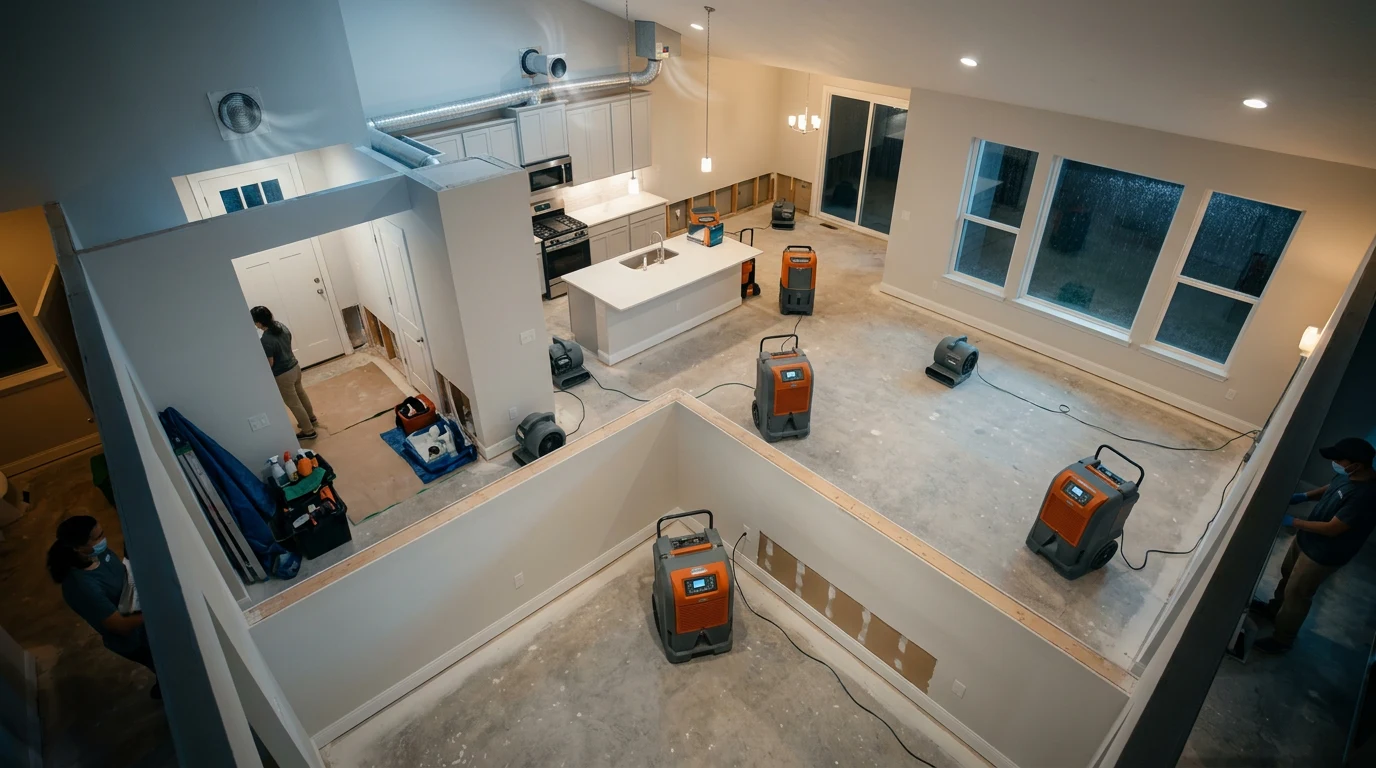
- Structural drying: $1,500-$3,000. Commercial dehumidifiers and air movers running 5-7 days to dry framing to acceptable levels.
- Basement reconstruction: $8,000-$12,000. New drywall, insulation, carpet, paint, trim, and electrical work.
- Kitchen reconstruction: $3,000-$5,000. New drywall, baseboards, cabinet reinstallation, and flooring.
- Post-remediation testing: $500-$800.
- Total: $25,000-$40,300
The homeowner’s insurance covered $18,000, leaving approximately $12,000 out of pocket. Their policy capped mold coverage at $10,000, and the adjuster determined that a portion of the damage was attributable to delayed response — something insurers consider a failure to mitigate. For a detailed understanding of remediation pricing, see our mold removal cost guide.
What Same-Day Response Would Have Looked Like
If the homeowner had called a water damage restoration company Friday evening — even at emergency after-hours rates — here is what the project would have looked like:
- Emergency water extraction (Friday evening): $500-$800. Truck-mounted extractors remove standing water within 1-2 hours. Carpet pulled back, pad removed.
- Drying equipment setup (Friday evening): $300-$500 for first day. Air movers and dehumidifiers placed in kitchen and basement.
- Drying equipment rental (3-4 days): $600-$1,200.
- Carpet pad replacement: $200-$400.
- Minor drywall repair (kitchen baseboards area): $300-$500.
- Total: $1,900-$3,400
No mold. No remediation. No basement demolition. No months of reconstruction. The 60-hour delay cost approximately $25,000 in additional damage.
The 48-Hour Rule: Why It Exists
The 48-hour window for mold prevention after water damage is not an arbitrary guideline. It is based on laboratory and field observations of mold colonization on building materials:
- Mold spore germination on drywall paper: 24-48 hours at 70+ degrees F and 60%+ relative humidity
- Mold spore germination on OSB and plywood: 24-72 hours under similar conditions
- Visible colony formation: 48-72 hours after germination
- Penetration of hyphae into material: Once germinated, hyphae (root structures) penetrate 1/16 to 1/4 inch into porous materials within days. At this point, surface cleaning is no longer effective — physical removal of the material is required.
The distinction is critical: before 48 hours, you are doing water damage restoration (drying). After 48 hours with active mold, you are doing mold remediation (demolition and environmental cleanup). The cost difference between these two services is typically 5-10 times. For guidance on the full remediation process, see our detailed guide on the mold remediation process.
Why People Wait (and Why It Always Costs More)
Understanding why homeowners delay helps you avoid the same mistakes:
- “It does not look that bad.” Water damage is deceptive. The visible puddle on the floor represents a fraction of the moisture absorbed into materials. By the time it looks bad — sagging ceilings, visible mold, warped floors — the damage is severe.
- “I will let it dry on its own.” Natural drying takes days to weeks depending on the volume of water and ventilation. Active drying with commercial equipment takes 3-5 days. The difference in drying time directly determines whether mold grows.
- “I do not want to pay emergency rates.” Emergency/after-hours water extraction typically costs 25-50% more than standard rates. For our example, that is an extra $200-$400. Compare that to the $25,000 in additional damage from waiting.
- “I need to call my insurance first.” You do not need insurance approval before taking mitigation steps. Every homeowner policy includes a duty to mitigate — you are required to take reasonable steps to prevent further damage. Document everything, keep receipts, and call insurance on the next business day.
- “It is the weekend.” Water damage restoration companies operate 24/7 with emergency response. This is literally their business model. Friday evening, Saturday, Sunday, holidays — they answer the phone.
Your Emergency Response Checklist
If you experience a flood or major water event, follow these steps immediately regardless of the day or time:
- Stop the water. Turn off the main water valve. Turn off electricity to affected areas if water is near outlets. Do this within minutes, not hours.
- Call a water damage restoration company. Search “emergency water damage restoration” + your city. Call the first company that answers. Response time should be under 2 hours. This is a drying company, not a mold company — you want to prevent mold, not treat it.
- Start extracting water yourself while waiting. Shop vac, towels, mops — remove as much standing water as possible. Every gallon you extract is moisture that will not feed mold growth.
- Move valuables out of the water. Lift furniture, remove rugs, relocate electronics, documents, and irreplaceable items to a dry area.
- Open windows and doors (if exterior humidity is lower than interior) to begin air circulation.
- Document everything. Photos, videos, and a written timeline starting from when you discovered the water. This protects your insurance claim.
- Call your insurance company within 24 hours. You do not need their permission to mitigate. File the claim and provide your documentation.
The difference between a homeowner who follows this checklist and one who waits is typically $10,000-$30,000 in avoided damage. For more information on responding to water events and preventing mold, the EPA’s mold cleanup guide provides authoritative guidance. For a complete step-by-step response protocol, see our complete guide to mold removal.
After the Emergency: Preventing the Next One
Once you have survived a flood event, take steps to prevent a repeat:
- Replace aging supply lines. Braided stainless steel hoses ($8-$15 each) replace every rubber hose under sinks, behind toilets, and on washing machines. Replace every 5 years.
- Install an automatic water shutoff valve. Systems like Flo by Moen, Phyn, or Guardian detect abnormal water flow and shut off the main valve automatically. Cost: $300-$600 installed. They would have stopped the leak in our scenario within minutes instead of hours.
- Place water sensors at high-risk locations. Under kitchen sinks, behind toilets, near water heaters, near washing machines, and in the basement. Smart sensors ($15-$30 each) alert your phone. Non-smart alarms ($10-$15 each) produce a loud tone.
- Know your shutoff valve location. Every household member should know where the main water shutoff is and how to operate it. Test it annually — valves that sit unused for years can seize.
- Inspect your water heater. Water heaters over 10 years old are high-risk for catastrophic failure. Place a drain pan underneath and ensure the temperature/pressure relief valve is functional.
For long-term moisture monitoring and prevention strategies, our guide on mold prevention products covers the tools and systems that catch moisture problems before they become mold problems.
Frequently Asked Questions
How quickly does mold grow after flooding?
Mold spores begin germinating on wet organic materials (drywall, wood, carpet) within 24-48 hours when temperatures are between 60-80 degrees Fahrenheit and relative humidity exceeds 60%. Visible mold colonies typically appear within 48-72 hours. In warm, humid conditions with no air circulation — like a closed basement after flooding — the timeline can be even faster.
Does insurance cover mold from flooding?
Most standard homeowner policies cover mold resulting from sudden, accidental water damage (burst pipe, appliance failure) but cap mold coverage at $5,000-$10,000. Policies typically exclude mold from external flooding (storm surge, river overflow) — that requires separate flood insurance through FEMA’s National Flood Insurance Program. Critically, insurers may reduce or deny mold claims if they determine the homeowner failed to take prompt mitigation steps. Responding immediately protects both your home and your claim.
Can I dry a flooded basement myself to prevent mold?
For minor flooding (less than 1 inch of clean water in a small area), DIY drying with a wet/dry vacuum, fans, and a dehumidifier can be effective if you start within hours. For significant flooding (standing water, multiple inches, large area, or water from any contaminated source), professional water extraction is strongly recommended. Professionals have truck-mounted extractors that remove hundreds of gallons per hour and commercial dehumidifiers that pull 3-5 times more moisture than residential units.
Should I remove carpet after a basement flood?
Always remove and discard the carpet pad — it absorbs 5-7 times its weight in water and cannot be effectively dried in place. The carpet itself can sometimes be saved if the water was clean (not sewage), extraction begins within 24 hours, and professional cleaning is performed. However, if the carpet has been wet for more than 48 hours, or if there is any visible mold or musty odor, discard the carpet as well. Carpet pad costs $0.50-$1.00 per square foot to replace — it is not worth the mold risk.
What is the “duty to mitigate” in insurance policies?
Nearly every homeowner’s insurance policy includes a clause requiring the policyholder to take reasonable steps to prevent further damage after a loss. This means you cannot discover a flood on Friday and wait until Monday to act. Reasonable steps include shutting off the water source, extracting standing water, and calling a restoration company. If an insurer determines you failed to mitigate, they can reduce your claim payout proportionally to the additional damage caused by the delay. Keep receipts for all mitigation expenses — these are reimbursable under the policy.
What caused the $30,000 mold problem described in the article?
The article explicitly states the mold problem originated from ‘The Flood,’ indicating a significant water intrusion event. This extensive water damage likely went unaddressed or was improperly remediated, creating the ideal conditions for widespread mold growth.
Is a $30,000 cost for mold remediation typical for a flood-related issue?
While specific costs vary greatly, a $30,000 bill for mold remediation following a flood suggests a very large-scale and severe infestation, likely affecting multiple areas or structural components. The extent of the water damage and the time it was left unaddressed significantly impact the final remediation cost.
What steps should I take immediately after a flood to prevent a costly mold problem like this?
After a flood, immediate and thorough drying of all affected areas and materials is critical to prevent mold growth. This includes removing standing water, using dehumidifiers and fans, and discarding porous materials that cannot be dried completely within 24-48 hours.
How quickly can mold develop after a flood, leading to such a large problem?
Mold can begin to grow within 24-48 hours of water exposure if conditions are favorable, meaning a large problem can develop quite rapidly if floodwaters are not promptly and thoroughly removed and dried. The longer moisture persists, the more extensive and costly the mold problem becomes.
What kind of damage does mold cause that would lead to a $30,000 remediation bill?
A $30,000 bill suggests extensive damage to structural elements like drywall, flooring, insulation, and potentially HVAC systems, all of which would need removal and replacement. The remediation process itself involves containment, removal of contaminated materials, cleaning, and often reconstruction.

Does homeowner’s insurance typically cover mold problems resulting from a flood?
Coverage for mold depends on the cause of the water damage; if the mold is a direct result of a covered peril like a sudden flood, it is often covered, though limits may apply. However, mold from long-term leaks or neglected maintenance is usually excluded.
These statements have not been evaluated by the Food and Drug Administration. This information is not intended to diagnose, treat, cure, or prevent any disease. Content is for informational purposes only and is not medical advice; consult a qualified healthcare provider before starting any supplement. As an Amazon Associate we earn from qualifying purchases.
