Benefect Botanical Disinfectant: The Thyme-Based Killer
Benefect Botanical Disinfectant stands out as a unique solution in the mold remediation market due to its primary active ingredient: thymol, derived from thyme oil. This makes it a truly botanical product, appealing to those who prioritize natural ingredients and wish to avoid synthetic chemicals. Benefect is an EPA-registered broad-spectrum disinfectant, meaning it’s proven to kill a wide range of bacteria, viruses, and, crucially for our discussion, fungi, including mold.
In lab dishes, thyme oil stopped molds from damp homes at low doses and beat clove, tea tree and rosemary oil
Stopped at under 20 micrograms per ml
Both thyme oil and pure thymol stopped the molds growing at concentrations below 20 micrograms per ml, except Mucor, which needed 50.20.
Spore production held back for 60 days
Vapor at 82 micrograms per liter of air strongly suppressed the molds from producing spores over 60 days of exposure.
Thyme needed the smallest dose
Thyme oil reached 97.43% inhibition at 5 µL. Clove needed 30 µL for 82.64%, tea tree 35 µL for 88.90%, and rosemary managed only 14.22% at 60 µL.
Thyme oil is one of the stronger botanical options in lab tests, but the moisture source still has to be fixed and badly affected porous material removed.
Lab studies on agar and in sealed chambers, not in homes. The four-oil comparison used food-spoilage mold strains. Source: Segvić Klarić et al., Letters in Applied Microbiology 2006; Vasile et al., Materials 2017
Embed this chart
Free to reuse on your site. Copy the code below; please keep the credit link.
Its mechanism of action is straightforward: the thymol in Benefect is described as disrupting the cell membranes of microorganisms. For mold, note that lab studies of thyme and similar essential oils measure the concentration that stops growth (a minimum inhibitory concentration), not a kill level, so the kill claim for this product rests on its EPA label rather than on that research. A significant advantage of Benefect is its “no rinse” formulation, which simplifies the application process, especially on hard, non-porous surfaces. It also boasts a pleasant, natural scent, a welcome change from the harsh odors often associated with conventional disinfectants.
Who is Benefect Best For?
Benefect Botanical Disinfectant is an excellent choice for individuals who:
- Prioritize natural and botanical ingredients: If you’re looking for a solution derived from plants and want to minimize exposure to synthetic chemicals, Benefect is a top contender.
- Need a broad-spectrum killer: While our focus is mold, Benefect’s label claim of killing 99.99% of fungi, bacteria, and viruses makes it a versatile disinfectant for overall household use, especially in areas where germs are a concern alongside mold.
- Are concerned about pets and children: Its kid/pet safe formulation after drying provides peace of mind for families with sensitive occupants.
- Prefer a no-rinse application: For hard surfaces that don’t require rinsing, Benefect simplifies the cleaning process.
- Are dealing with visible, active mold growth: Benefect is labeled to kill mold on hard, non-porous surfaces.
Research note: In the lab, minimum inhibitory concentrations of oregano, thyme, clove and arborvitae oils against five indoor molds ranged from 0.01% to 0.075%, a growth-stopping level and not a kill level.[1] More research-backed mold statistics
Pros of Benefect Botanical Disinfectant
- Botanical Formula: Made with thymol, derived from thyme oil, offering a natural alternative to synthetic chemicals.
- EPA-Registered Disinfectant: Label claim of killing 99.99% of fungi, bacteria, and viruses, including mold.
- No Rinse Required: Simplifies application on many surfaces, saving time and effort.
- Kid/Pet Friendly Label: Once dry, the label describes it as safe around children and pets. Natural is not the same as harmless, though: in the lab, thyme-type essential oils were toxic to human lung cells at doses not far above those that stop mold growth.
- Pleasant Scent: Has a natural, mild scent, avoiding the harsh chemical odors common with other disinfectants.
- Non-Corrosive/Non-Fuming: Generally safe for most surfaces and doesn’t produce irritating fumes.
Cons of Benefect Botanical Disinfectant
- No Residual Protection Against Regrowth: While it is labeled to kill existing mold, it doesn’t leave a protective barrier to prevent future mold growth. This means reapplication might be necessary if moisture issues persist.
- May Require Cleaning Before Application: For heavy mold growth, pre-cleaning may be necessary to allow Benefect to properly contact and kill the mold.
- Check Current Pricing on Amazon: Like many specialized products, it’s important to check current pricing on Amazon to ensure it aligns with your budget.
- Limited Stain Removal: While it kills mold, it may not remove deep-set mold stains, which might require additional cleaning efforts.
Concrobium Mold Control: The Physical Barrier
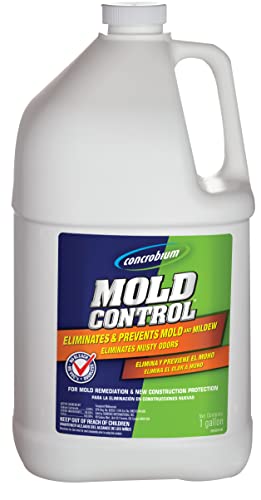
Concrobium Mold Control takes a fundamentally different approach to mold remediation compared to Benefect. Instead of a botanical disinfectant, Concrobium is an EPA-registered product that utilizes a unique tri-salt polymer technology. Its primary function is not to chemically kill mold, but rather to physically eliminate it and prevent its return.
When applied, Concrobium forms an invisible, ultra-thin layer over the mold. As this layer dries, it physically crushes the mold spores at a microscopic level, effectively destroying them. This mechanical action is highly effective and differentiates it from bleach or other chemical killers. Furthermore, the dried polymer layer remains on the surface, creating an invisible barrier that actively prevents new mold spores from attaching and growing. This preventative aspect is a significant advantage, offering long-term mold control without the need for harsh chemicals. It’s also notable for being bleach-free, odorless, and non-toxic.
Who is Concrobium Best For?
Concrobium Mold Control is an excellent choice for individuals who:
- Need long-term mold prevention: Its unique polymer barrier offers sustained protection against future mold growth, making it ideal for areas prone to recurrent mold.
- Want a bleach-free and odorless solution: If you’re sensitive to strong smells or wish to avoid bleach, Concrobium is a great alternative.
- Are looking for a non-toxic option: Concrobium is non-toxic and leaves no harmful residue, making it suitable for use in homes with children, pets, or individuals with sensitivities.
- Are dealing with mold on various surfaces: It’s safe for use on a wide array of surfaces, including porous materials like drywall, fabric, and wood, where bleach might cause damage or discoloration.
- Prefer a product that removes stains as it works: The physical crushing action often helps lift and remove mold stains, improving the aesthetic appearance of affected areas.
Pros of Concrobium Mold Control
- Prevents Regrowth: Its primary strength is the invisible barrier it forms, which actively prevents new mold spores from growing, offering long-term protection.
- Bleach-Free and Odorless: A major advantage for those sensitive to strong chemical smells or wishing to avoid bleach’s corrosive properties.
- Non-Toxic: Safe for use around people and pets, and leaves no harmful residue.
- Physical Mechanism: Crushes mold spores as it dries, rather than relying on harsh chemicals.
- Versatile Application: Effective on a wide range of surfaces, including porous materials like drywall, fabric, and wood, without discoloration.
- Removes Stains: Often helps lift and remove existing mold stains, improving the appearance of surfaces.
- EPA-Registered: A recognized and approved solution for mold control.
Cons of Concrobium Mold Control
- Requires Scrubbing for Heavy Growth: While it crushes spores, significant visible mold may still require light scrubbing with a brush or cloth after application to physically remove the residue and stains.
- Not a Disinfectant: Unlike Benefect, Concrobium is not registered as a disinfectant against bacteria and viruses; its focus is specifically on mold.
- Drying Time: The product needs to dry completely for the physical crushing action to occur and the protective barrier to form.
- Check Current Pricing on Amazon: As with any product, it’s advisable to check current pricing on Amazon to ensure it fits your budget.
Benefect vs Concrobium: Which is the Best Natural Mold Killer?
When comparing Benefect Botanical Disinfectant and Concrobium Mold Control, it’s clear that both offer compelling advantages as “natural” approaches to mold, but they excel in different areas. There isn’t a single “best” product; rather, the optimal choice depends on the specific nature of your mold problem and your priorities.
For Immediate Killing and Disinfection: Choose Benefect
If your primary concern is to quickly and effectively kill existing mold, along with other fungi, bacteria, and viruses, Benefect Botanical Disinfectant is likely your best bet. Its botanical, thymol-based formula is labeled as a broad-spectrum disinfectant. It’s ideal for situations where you need to sanitize a surface thoroughly and prefer a natural, kid/pet safe product with no rinsing required. Think of it as your go-to for actively infected areas where you want a product with an EPA-labeled kill claim.
For Long-Term Prevention and Stain Removal: Choose Concrobium
If your main goal is to prevent mold regrowth, especially in areas prone to moisture or recurring mold, and to also tackle existing stains, Concrobium Mold Control shines. Its unique physical action crushes spores and, critically, leaves behind an invisible barrier that inhibits future mold growth. This preventative aspect is invaluable for basement walls, bathroom ceilings, or any area where you want to break the cycle of mold recurrence. Its bleach-free and odorless nature also makes it highly appealing, and its ability to work on porous surfaces without damage is a significant plus.
Can You Use Them Together?
In some comprehensive mold remediation scenarios, a synergistic approach might be considered. You could potentially use Benefect Botanical Disinfectant first to thoroughly kill active mold and disinfect the area, followed by an application of Concrobium Mold Control to establish a preventative barrier against future growth. However, always ensure surfaces are completely dry between applications and follow each product’s specific instructions for best results. This combined approach would leverage Benefect’s killing power and Concrobium’s preventative capabilities.
Ultimately, both Benefect and Concrobium offer effective, safer alternatives to traditional harsh chemicals for mold control. Your choice between them, or even a combination, should be guided by whether your priority is immediate kill and broad disinfection (Benefect) or long-term prevention and stain removal (Concrobium).
Frequently Asked Questions
Is Benefect truly natural?
Benefect Botanical Disinfectant’s active ingredient is thymol, which is derived from thyme oil, and it avoids harsh fumes, making it a popular choice for those seeking botanical solutions. Natural does not mean harmless, though: in lab tests, thyme-type essential oils were toxic to human lung cells at doses not far above those that stop mold growth.
Does Concrobium kill mold or just encapsulate it?
Concrobium Mold Control physically kills mold spores. When it dries, its unique tri-salt polymer technology crushes the mold spores at a microscopic level. It doesn’t just encapsulate them; it actively destroys them and then leaves an invisible barrier to prevent future growth.
Can I use Benefect or Concrobium on porous surfaces like drywall or wood?
Both products can be used on porous surfaces. Benefect Botanical Disinfectant is generally safe for most surfaces, but it is labeled for hard, non-porous surfaces, and viable spores within porous surfaces may be unaffected and become dormant when an antifungal is applied. Concrobium Mold Control is gentler on porous surfaces like drywall, wood, and fabric because it won’t bleach or damage them, but removing badly affected porous material is the reliable fix.
Do I need to scrub after applying Benefect or Concrobium?
For Benefect Botanical Disinfectant, if there is heavy visible mold, pre-cleaning or light scrubbing after application might be necessary to remove the physical mold residue and stains, even after the product has killed it. For Concrobium Mold Control, while it crushes the spores, visible mold stains or residue often require light scrubbing with a brush or cloth after the product has dried to fully remove them and reveal a clean surface.
Are Benefect and Concrobium safe for pets and children?
Yes, both products are formulated with safety in mind. Benefect Botanical Disinfectant is kid/pet safe once it has dried. Concrobium Mold Control is non-toxic, bleach-free, and odorless, making it safe for use around children and pets without leaving harmful residues. Always ensure proper ventilation during application and follow label instructions.
References
- The antibacterial and antifungal activity of six essential oils and their cyto/genotoxicity to human HEL 12469 cells. Scientific reports, 2017
These statements have not been evaluated by the Food and Drug Administration. This information is not intended to diagnose, treat, cure, or prevent any disease. Content is for informational purposes only and is not medical advice; consult a qualified healthcare provider before starting any supplement. As an Amazon Associate we earn from qualifying purchases.