Clorox vs Concrobium for Mold: Tested Comparison
Affiliate disclosure: As an Amazon Associate, MoldActionPlan earns from qualifying purchases. Links in this article marked with an asterisk (*) are affiliate links and we may earn a commission at no extra cost to you.
Quick Verdict
Concrobium wins for most homeowners. It kills mold at the root on porous surfaces (drywall, wood, fabric) without bleach, fumes, or risk of damaging your materials. Clorox Plus Tilex wins for fast stain removal on hard, nonporous surfaces (tile, shower doors, fiberglass) where you want instant results and do not mind a strong bleach smell.
If you need to make black spots on grout or tub caulk disappear in minutes, grab Clorox. If you have mold on drywall, ceiling, wood framing, or anywhere porous, or if you want an odorless treatment for an occupied home, buy Concrobium. Each product dominates a different use case, and choosing wrong means wasted effort or even damaged surfaces.
At-a-Glance Comparison
| Feature | Clorox Plus Tilex | Concrobium Mold Control |
|---|---|---|
| Active Ingredient | Sodium Hypochlorite 2.4% (bleach) | Sodium Carbonate 1.0% |
| EPA Reg Number | 5813-24 | 82552-1 |
| Price (32 oz) | $12.05 (single)* or $17.28 (3-pack)* | $13.48 (spray bottle)* |
| Price per oz | $0.14 to $0.38 | $0.42 |
| Kills Mold | Yes (99.9%) | Yes (crushes spores) |
| Removes Stains | Yes, instantly | No (scrubbing needed after) |
| Dwell Time | 5 min nonporous, 10 min porous | Let dry completely (several hours) |
| Smell | Strong bleach odor | Odorless |
| Safe on Drywall / Wood | No | Yes |
| Regrowth Barrier | Up to 4 weeks | Yes (invisible barrier until wiped) |
| Surface Type | Nonporous only (tile, glass, vinyl) | Porous and nonporous |
| Amazon Rating | 4.7 stars (1,000+ ratings) | 4.1 stars (2,000+ ratings) |
Product A: Clorox Plus Tilex Mold and Mildew Remover
Clorox Plus Tilex is the bleach-based classic that has been a bathroom staple for decades. It uses 2.4% sodium hypochlorite (household bleach) to kill 99.9% of mold and mildew on contact while simultaneously whitening the surface it touches. It is sold as a ready-to-use spray in 16 oz and 32 oz bottles, often in value multi-packs that bring the per-bottle cost down significantly.
On the CloroxPro website, the product carries EPA registration number 5813-24 and is classified with a “Warning” signal word for toxicity. Its active ingredient is the same bleach chemistry found in laundry products, reformulated with surfactants to cling to vertical surfaces in showers and penetrate mildew films.
Strengths
- Instant stain removal. Spray it on black mold spots in a tile shower and watch them fade in as little as 3 to 5 minutes. No scrubbing needed for recent growth. Verified Amazon customers consistently describe seeing results “before your eyes.”
- Hard surface disinfectant. EPA registered to kill Staphylococcus aureus, Streptococcus pyogenes, Athlete’s Foot fungus (Trichophyton mentagrophytes), and SARS-CoV-2 with just a 1-minute contact time for the virus. If you need sanitation and mold removal in one product, this does both.
- Low cost per use. The 3-pack of 32 oz bottles works out to roughly $0.18 per ounce, one of the cheapest mold killers on the market. One bottle handles a typical bathroom for months of spot treatments.
- Fast dwell time. Wait 5 minutes on nonporous surfaces, rinse, and you are done. No overnight drying or multiple steps. For quick bathroom touch-ups this is the fastest option available.
- Proven track record. Over 1,000 Amazon ratings averaging 4.7 stars. Customers consistently call it their “go-to” for shower mold. The product has been on the market for over 35 years.
Weaknesses
- Strong bleach fumes. You need windows open and a fan running. The smell lingers for hours. Not suitable for occupied bedrooms, nurseries, or anyone with asthma or chemical sensitivities.
- Damages porous surfaces. Bleach soaks into drywall, wood, and fabric but does not kill mold deep inside those materials. The moisture can actually feed regrowth behind the surface where you cannot see it. Do not use on drywall, unfinished wood, unsealed grout, or carpets.
- Bleaches fabrics and clothing. A splash on a towel or bathmat leaves a permanent white spot. Protect all fabrics in the area and wear old clothes during application.
- Short prevention window. Clorox claims regrowth prevention up to 4 weeks on hard surfaces. In practice, in a continuously damp bathroom, spots can return sooner. This product is best as a cleaner, not a long-term mold preventative.
- Packaging issues. Multiple Amazon reviews report trigger sprayers leaking during shipping, arriving with bottles half-empty.
Best Use
Tile showers, glass shower doors, fiberglass tubs, vinyl shower curtains, glazed ceramic tile, sealed grout, sink basins, and outdoor patio furniture. Avoid wood, drywall, fabric, natural marble, brass, and any surface you care about keeping its original color.
Check price on Amazon* – 3-pack of 32 oz bottles, $17.28. The best value option with 10,000+ units sold per month.

Check price for a single 32 oz bottle* – around $12.05 if you only need one.
Product B: Concrobium Mold Control
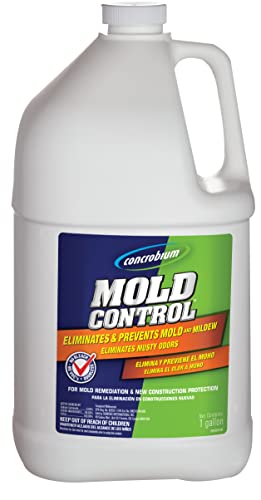
Concrobium Mold Control is a bleach-free, odorless mold treatment built around 1.0% sodium carbonate plus trisodium phosphate and alkali metal carbonates. Instead of bleaching mold away on the surface, it encapsulates and physically crushes mold spores as it dries, leaving an invisible antimicrobial barrier that resists future growth.
EPA registered under number 82552-1, Concrobium carries no toxicity signal word and holds EPA Safer Choice certification, meaning its ingredients meet the agency’s criteria for safer human and environmental health. The 32 oz trigger spray retails for $13.48 at the time of writing, with over 10,000 units bought in the past month on Amazon. A 1-gallon refill costs $35.99 and brings the per-ounce cost down to about $0.28.
Strengths
- Safe on almost every surface. Works on drywall, wood, concrete, tile, grout, vinyl, fabric, upholstery, brick, stone, and siding. This is the decisive advantage over bleach products. You can treat a basement drywall ceiling or a wooden window frame without damaging anything.
- Odorless and low-toxicity. No bleach smell and no VOCs. You can treat a room while people and pets are home (with reasonable precautions). EPA Safer Choice certified and biodegradable.
- Kills at the root on porous surfaces. Bleach stays on the surface. Concrobium penetrates into drywall and wood where mold roots live and destroys the spore structure as the solution dries.
- Creates a lasting barrier. An invisible film remains on treated surfaces that blocks new spores from germinating. On porous surfaces, this barrier persists until physically removed by cleaning.
- Large area practicality. The 1-gallon jug can be used with a pump sprayer or fogger to treat up to 1,440 square feet, making it realistic for whole-basement or crawlspace jobs.
Weaknesses
- Does not remove stains. Concrobium kills mold but does not bleach or whiten. After treatment you may still see dark discoloration. Many lower Amazon ratings come from people who expected stain removal, which is not what the product is designed to do.
- Slower process. You spray, let dry for hours, then scrub off the killed residue. For large areas this takes most of a day compared to Clorox’s 5-minute rinse cycle.
- Higher per-oz cost at smaller sizes. The 32 oz trigger spray costs $0.42 per ounce. The gallon refill drops to $0.28. The upfront is higher but the value flips for big jobs.
- Sprayer reliability. Multiple verified Amazon reviews report the trigger sprayer leaking or failing after a few uses. Buying the gallon and using your own spray bottle is a common workaround.
- Mixed reviews overall. The 4.1-star rating from 2,000+ reviews is lower than Clorox’s 4.7, driven partly by the stain removal confusion and partly by sprayer complaints.
Best Use
Basement drywall, wooden window sills and frames, attic rafters, fabric upholstery, concrete walls, drywall ceilings, crawl spaces, and any porous surface where bleach would cause damage. Also ideal for large areas where ventilating bleach fumes is impractical, such as unfinished basements and crawlspaces.
Check price on Amazon* – 32 oz spray bottle, $13.48. Best for small to medium jobs.
Check price for 1-gallon refill* – $35.99, roughly $0.28 per ounce. The right choice for whole-room or basement-scale work.

Head-to-Head Comparison
Effectiveness Against Mold
Both kill mold effectively when used on the right surface. Clorox kills surface mold instantly on hard, nonporous surfaces. Concrobium kills mold at the root on porous surfaces. If you compare them on tile, Clorox is faster and leaves a visibly cleaner surface. On drywall, only Concrobium penetrates deep enough to address the problem. The wrong product on the wrong surface is not just ineffective. It can make things worse. Bleach on drywall adds moisture that feeds mold growth behind the surface.
Safety
Concrobium wins clearly. It is odorless, VOC-free, and EPA Safer Choice certified. Clorox Plus Tilex carries a “Warning” signal word, requires full ventilation, and can cause eye and skin irritation. For households with children, pets, or anyone with asthma or chemical sensitivities, Concrobium is the safer choice by a wide margin.
Smell
Clorox smells like a swimming pool for hours after use. The odor can be strong enough to drive people out of the room. Concrobium has no smell at all. If a product’s scent matters in your home, this alone may decide the winner.
Cost Per Use
Clorox is cheaper on small, frequent jobs. A few sprays on a shower corner cost pennies. For a whole-room treatment, Concrobium’s gallon format is more economical. At $0.28 per ounce versus Clorox’s $0.18 per ounce in the 3-pack, Clorox looks cheaper by volume. But Clorox is only usable on hard surfaces, while Concrobium works everywhere. The effective cost depends on how much of your mold problem is on porous materials.
Ease of Use
Clorox is simpler for quick jobs: spray, wait 5 minutes, rinse, done. Concrobium requires drying time and post-treatment scrubbing. But Concrobium does not require you to clear the room or mask up. In practice, for occupied homes, the lower safety burden often makes Concrobium easier to use day to day.
Which to Choose by Scenario
Bathroom Shower (Tile and Glass)
Choose Clorox Plus Tilex. Fast stain removal, no scrubbing, and the bleach whitens grout lines. Plan for ventilation. The 3-pack* is the best value for ongoing maintenance in a household with multiple bathrooms.
Basement Drywall or Wood Framing
Choose Concrobium. Bleach will not penetrate drywall and the added moisture can worsen the mold problem behind the surface paper. Concrobium soaks into porous materials, kills spores at the root, and leaves a protective barrier. The 1-gallon refill* is the right size for basement-scale work.

Outdoor Decks, Siding, Patio Furniture
Both can work depending on the material. Clorox is faster on hard outdoor surfaces like plastic patio furniture, glazed pool tile, and vinyl siding. Concrobium is better on wood decks and wood siding. Bleach runoff can also kill plants and grass near the treated area, while Concrobium is biodegradable and safer around landscaping.
Fabric, Upholstery, Carpet
Only Concrobium. Bleach destroys fabric permanently. Concrobium is safe on fabric and upholstery. Spray the affected area, let dry completely, then vacuum the residue. This is the one application where there is no debate between the two products.
Large Area Treatment (Attic, Crawlspace, Unfinished Basement)
Choose Concrobium. Ventilating bleach fumes through a crawlspace or attic is impractical and hazardous. Concrobium can be applied with a pump sprayer or fogger without respiratory protection beyond a basic mask. The gallon size* provides the lowest cost per square foot for these jobs.
Ongoing Prevention Program
Use both in rotation. Keep Clorox Plus Tilex for weekly shower maintenance on hard surfaces. Keep Concrobium for periodic deep treatment of porous materials and for any area where you see mold returning despite cleaning. Address the underlying moisture issue regardless of which product you choose.
How to Use Each Product Correctly
Using Clorox Plus Tilex on Bathroom Tile
- Open windows and turn on the bathroom exhaust fan. Wear rubber gloves. Protect nearby fabrics (towels, bathmats, shower curtains).
- Pre-clean visible soap scum or grime with a basic all-purpose cleaner. Bleach works better on a clean surface.
- Turn the nozzle to ON. Spray Clorox Plus Tilex directly onto moldy areas until thoroughly wet.
- Let stand for 5 minutes. Do not scrub during this time. The bleach is doing the work.
- Rinse thoroughly with water. For heavy buildup, a second application may be needed after the surface dries.
- Wipe dry to prevent water spots. The surface is now disinfected and mold-free.
Using Concrobium on Porous Surfaces (Drywall or Wood)
- Wear gloves and eye protection. A basic dust mask is recommended when scrubbing dry mold debris.
- Spray Concrobium Mold Control directly onto the affected area until the surface is wet but not dripping.
- Allow to dry completely. This takes 2 to 4 hours on drywall in normal indoor conditions, longer on wood or concrete. The product works as it dries by crushing mold spore structures.
- Once dry, scrub with a Concrobium-dampened cloth or brush. This removes the killed mold residue and any remaining surface stains.
- Vacuum or wipe away the debris. Dispose of cleaning cloths in a sealed plastic bag.
- For ongoing prevention, apply a second thin coat and let dry without scrubbing. The invisible barrier left behind will resist new mold growth.
- Fix the moisture source. No mold treatment is permanent if the humidity, leak, or condensation that caused the problem is not addressed.
When to Consider Alternatives
If neither Clorox nor Concrobium fits your situation, a few other products fill specific gaps:
- RMR-86 Instant Mold and Mildew Stain Remover* is the strongest stain remover for stubborn mold stains on hard surfaces. It works faster than Clorox on heavy buildup and is popular with contractors. Priced around $25.99 for a 2-pack on Amazon.
- CLR Mold and Mildew Stain Remover* is a bleach-free option that actually removes stains (unlike Concrobium). EPA Safer Choice certified and costs about $11.04 for a 2-pack. Good for people who want no-bleach stain removal on hard surfaces.
Frequently Asked Questions
Can I mix Clorox and Concrobium together?
No. Never mix any bleach-based product with other chemicals. Mixing bleach with other cleaners can release toxic chlorine gas. Use one product or the other, never both at the same time on the same surface.
Does Concrobium actually kill black mold?
Yes. Concrobium is EPA registered (82552-1) specifically for mold control. Its active sodium carbonate formula penetrates porous surfaces and destroys mold spore structures as it dries. It is effective against Stachybotrys chartarum (black mold) and other common household molds when used as directed.
Is bleach better than Concrobium for killing mold?
On hard, nonporous surfaces like tile and glass, bleach (Clorox Plus Tilex) is faster and provides visible stain removal. On porous surfaces like drywall and wood, bleach only kills surface mold while leaving the roots intact. The added moisture can actually feed regrowth. Concrobium penetrates porous materials and kills at the root. The best choice depends entirely on the surface you are treating.
How long does Concrobium take to dry?
Drying time varies by surface, humidity, and temperature. On drywall in normal indoor conditions, figure 2 to 4 hours. On wood or concrete, it can take 4 to 6 hours. The product must be fully dry to complete its spore-crushing action. Do not wipe or rinse it off before it dries.
Can I use Clorox Plus Tilex on painted walls?
No. The bleach will strip paint and discolor the surface. For mold on painted drywall, use Concrobium Mold Control, which is safe on painted surfaces and will not affect the finish.
Which is cheaper, Clorox or Concrobium?
By volume, Clorox is cheaper. The 3-pack of 32 oz bottles is $0.18 per ounce versus Concrobium’s 32 oz spray at $0.42 per ounce. But the comparison is misleading because the two products are not interchangeable on most surfaces. You cannot use Clorox on drywall or wood, so if those materials are part of your mold problem, Concrobium is the only relevant option.
These statements have not been evaluated by the Food and Drug Administration. This information is not intended to diagnose, treat, cure, or prevent any disease. Content is for informational purposes only and is not medical advice; consult a qualified healthcare provider before starting any supplement. As an Amazon Associate we earn from qualifying purchases.